Tuesday, 31 January 2012

Plot Development

This is a rough storyline I wrote up to help me draw my storyboard.

More Storyboarding

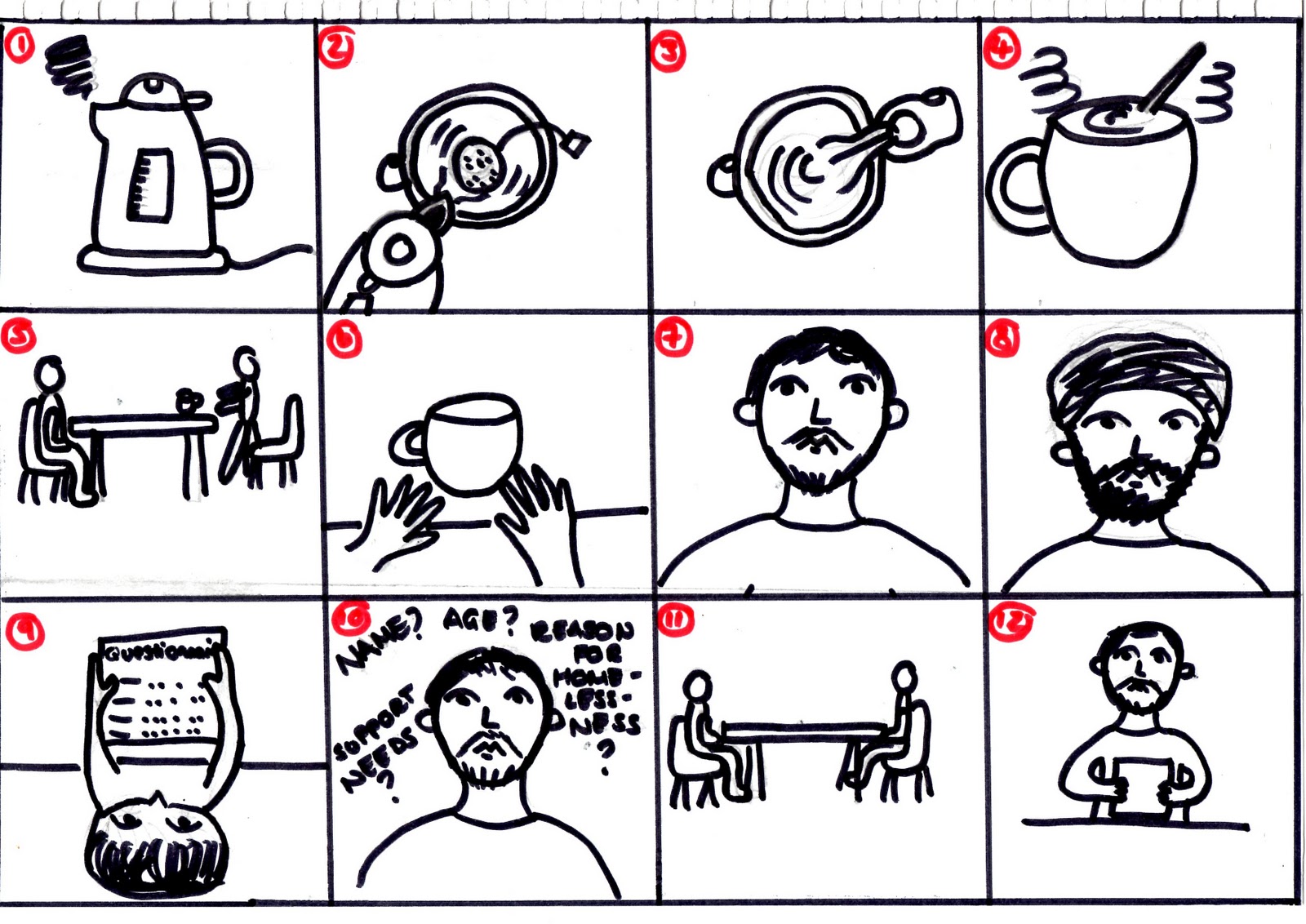
I decided to draw up a storyboard as a way of visualising my ideas so far in an attempt to assess what works and what doesn't and to notice any holes in the storyline.

Shot Description
  1. ECU of kettle boiling.
  2. ECU of boiling water being poured into a tea cup.
  3. ECU of milk being poured into a tea cup.
  4. ECU of tea being stirred.
  5. Establising shot of table - Homeless Man (HM) is already sat down, Support Worker (SW) walks into shot with cup of tea and sits down.
  6. ECU of SW sliding cup of tea over to HM.
  7. CU of SW.
  8. CU of HM.
  9. Overhead shot of SW picking up questionnaire and reading.
  10. CU of SW with questions from questionnaire floating around his head - either projected there or layered on top of the clip with the matte tool. There will also be a voice over of SW reading the questions aloud in his head.
  11. Establishing shot of the two characters at the table again.
  12. Shot of SW at one end of the table looking in direction of HM.
  13. Shot of HM at other end of table looking in direction of SW.
  14. CUof both characters merging into each other through a long cross dissolve.
  15. ECU of SW eyes.
  16. ECU of HM eyes.
  17. CU of SW looking slightly confused.
  18. Over-the-shoulder shot of SW at one end of table.
  19. ECU of HM sliding cup of tea to SW.
  20. CU of SW looking really concerned.
  21. CU of HM.
  22. CU of SW surrounded by small interview clips of people describing homelessness and homeless people. These will be either projected or layered on top of the clip.
  23. Really quick shot - CU of SW in HM clothes examining himself.
  24. Over-the-shoulder shot of HM at opposite end of table in his own clothes again.

Friday, 27 January 2012

Further Ideas Development

Following the Dyer reading I completed yesterday, I have been thinking a lot about looking at the stereotypes of homelessness critically. The reading suggested placing the character representing a certain stereotype into a place or situation in which the audience wouldn't expect to find them.
One of the initial sequences for my film included an interview of the homeless individual. This idea was taken from my own experience working in a woman's night shelter. Every time a new woman came into the shelter we had to complete a questionnaire with them asking some quite personal questions in order to get an idea of the kind of support they may need, and to assess whether or not they were a risk to others within the shelter. Having read the Dyer reading, I have had the idea of switching roles in this sequence and have the homeless individual interviewing a non homeless person, possibly a support worker.

I have thought about setting the whole film in a night shelter with the main plot following this interview sequence. I would still like to include the shadow sequence and thought I could include some slightly surreal sequences exploring how stereotypes help us grasp reality and the effects re-positioning a stereotyped character has on our understanding of the concepts of this reality. I would also like to possibly include a 'puppet master' element to make the audience question who constructs these stereotypes. I was thinking that this may be a way I could literally incorporate the shadow element, possibly using shadow puppets - something I would need to look into.

I am meeting with Natalia again on Tuesday afternoon to discuss and develop our ideas further but hopefully this will form the basic storyline for my film. Both homelessness and stereotypes are very broad subjects which could take many possible directions so I still have a lot of reading to do and at the moment I am still open to this idea changing directions, but hopefully the more I read, the more strength I can bring to build this idea and take it into production.

Thursday, 26 January 2012

Research: Stereotypes.

The Matter of Images: Essays on Representation.
Chapter 3: The Role of Stereotypes.
By Richard Dyer

Dyer, R (2002) The Matter of Images: Essays on Representation. London: Routledge.

This chapter looks at the role of stereotypes within society. It brought up some particularly interesting ideas which I feel will definately help influence the development of my film.

In this chapter, Dyer talks about stereotypes being used as a means of creating and making sense of the reality in which we live.
"...stereotypes express particular definitions of reality, with concomitant evaluations, which in turn relate to the disposition of power within society." (Dyer, R: 2002: 14)
The link between stereotypes and reality is something I would like to explore within my film as I feel it would really give me an opportunity to express the theme of homelessness in a much more creative way.

Dyer introduces and quotes the work of Walter Lippman who, "...refers to stereotypes as a projection on to the 'world'." (Dyer, R: 2002:13) The idea of a stereotype as a cultural projection is again an interesting concept. I have mentioned my eagerness to experiment with shadows and lighting in this project and this has made me think about the possibility of taking this quote literally and working with projections. My production partner Natalia used lots of projections throughout her last film and this was really effective. If I were thinking of experimenting with this technique then I'm sure whe could offer some useful tips.

In my tutorial with Rod earlier this week, we discussed the problems with stereotypes. In this chapter, Dyer further emphasises this. He describes stereotypes as having two key problems:
  1. Society begins to see them as literal, rigid information about that particular character; failing to separate an individual from a stereotype. "...the need to order 'the great blooming, buzzing confusion of reality' is liable to be accompanied by a belief in the absoluteness and certainty of any particular order, a refusal to recognize its limitations and partiality, its relativity and changeability, and a corresponding incapacity to deal with the fact and experience of blooming and buzzing." (Dyer, R:2002: 12)
  2. Stereotypes are influenced heavily by those of a higher social power than the majority, therefore they can be manipulated. "...as Berger and Luckmann put it, 'he who has the bigger stick has the better chance of imposing his definitions of reality'..." (Dyer, R: 2002: 12)
Dyer goes on to discuss the use of stereotypes in fiction. He says that fictional characters representing a certain stereotype don't develop beyond the stereotype throughout the duration of the film. They remain the same. He also explains that if we are going to watch a film in which the main character represents a certain stereotype, we will already have an idea of the storyline, or key elements of the plot. He uses the example of alcoholism to back this point:
"...we surely only have to be told that we are going to see a film about an alcoholic to know that it will be a tale either of sordid decline or of inspiring redemption." (Dyer, R: 2002: 15)
This is the main problem Rod described with my film. I don't want the audience to be able to pre-empt what is going to happen before watching the film. I want it to be a unique and unexpected take on the theme of homelessness. Dyer does however, offer a suggestion for how to avoid falling into the trap of stereotypes:
"(This suggests a particularly interesting potential use of stereotypes, in which the character is constructed, at the level of dress, performance, etc., as a stereotype but is deliberately given a narrative function that is not implicit in the stereotype, thus throwing into question the assumptions signalled by the stereotypical iconography.)" (Dyer, R: 2002: 15)

Monday, 23 January 2012

Images of Homeless People

The following is a selection of images taken from the St Petrock's Annual Report Newsletter.


The following are some images I found on the internet after searching 'homelessness':


Tutorial 1: 23rd January 2012

Today I meet my module leader to discuss my project. I was keen to do this as I know I'm going to have a lot of pressure on me this term with regards to my work load at university and the BBC Second Screens project.

Having talked through my ideas, we discussed the areas I need to develop and research further, and the various issues I may encounter.

1) Stereotypes.
One of the aims of my film is to make the audience re-think the stereotypes surrounding homelessness. As I have spent the last two years working closely in different centres for the homeless I have built up a working knowledge of the homeless community in Bristol - this will be a great help when making this project.
However, my module leader, Rod, voiced his concerns about falling into 'stereotype traps'. Unless I plan and create the story of my film very thoroughly and carefully there is a chance I may end up simply re-emphasising the existing stereotypes to the audience. I really don't want to do this. Rod's advice on this matter was to create a story that was less literal than the storyboards shown in previous blog entries. I need to find a more innovative and possibly risky way of exploring the theme of homelessness. My experience in this field should work to my advantage, but in the meantime I am going to explore how different films deal with stereotypes. I have struggled to find films with the main theme of homelessness so Rod has advised that I don't narrow my viewing simply to this subject, and instead explore different stereotypes in general. Having watched a variety of films, I will be able to uncover what works and what doesn't.
I need to find a way of articulating homelessness that offers a different perspective, is unusual and interesting, while not being too literal.

Form.
My film 'Scopo Networking' was influenced heavily by Jeremy Bentham's Panopticon idea, and this was heavily echoed throughout my film. As a result, my film was very successful and I had a clear method for creating each scene through simply putting my research into practise.
I haven't looked into any theories that could help shape my project so this is something I really need to do.
I am feeling a lot of pressure to create a film that is as successful as 'Scopo Networking' but I can only combat my concerns by working even harder on this project.

Imagery.
Rod has suggested I create an inventory of images that tie in with the theme of homelessness and the stereotypes surrounding it. I am currently conducting a study into homelessness for my dissertation and have got a newsletter from a day centre I visited in Exeter which has some wonderful images of the service users in it. I will upload these on to my blog shortly.

Following this tutorial I went to the library and took out three books:
  • 'The Matter of Images: Essays on Representation' by Richard Dyer (Dyer, R: 2002: The Matter of Images: Essays on Representation. London: Routledge)
  • 'About Looking' by John Berger (Berger, J: 1980: About Looking. London: Writers and Readers Publishing)
  • 'Understanding Representation' by Roy Ashbury et al. (Ashbury, R et al: 2005: Understanding Representation. London: British Film Institution.
I have skimmed through and have selected some chapters which I think will help me get inspired and will read these fully. I am also going to continue coming up with ideas and locating images to help shape my film successfully.

Production Meeting 1: 19th January 2012

Today I had my first meeting with my production partner Natalia. Natalia and I worked on a film project together last year, and our partnership was successful.

The aim of our meeting today was just to discuss the initial ideas we had for our individual projects this year, and come up with a successful and organised production schedule. Natalia and I both felt that we needed to work on a tight schedule in order to successfully split our time effectively over all elements of the production process.

Natalia wants to create a scripted film which is something neither of us has done before, however, I am currently acting in a scripted film for another student project so have been able to get an idea of the kind of work she will need to put in, and will hopefully be able to offer some advice based on what I've seen.

Today we had a very broad discussion as neither of our film storylines are fully formed yet. Following this we have each come up with a to do list of things to complete before our next meeting which we are aiming to have in a week's time.

To Do List:
  1. Begin researching the subject matter addressed in the film, and any practical film techniques or theories that may be useful.
  2. Complete/construct a plot.
  3. Create character profiles for the characters within the film.
  4. Write a rough draft of a script - if and where needed.
  5. Begin storyboarding.
We also came up with a rough production plan based on the 15 weeks we have from the date of this meeting till our hand in date on 1st May 2012:

23rd January - 13th February 2012: Pre-Production.
  • Planning, storyboarding, scripting, finding actors, location hunts, risk assessment forms etc.
13th  - 20th February 2012: Practice Shoot.
  • Practise film in the selected locations to see what works and what doesn't.
  • Also experimentation in post-production to find out whether anything needs to be filmed in a certain way in order to master a desired effect when editing.
20th - 12th March 2012: Filming.
  • 3 weeks set aside for all the filming needed.

12th March - 9th April 2012: Editing.
  • 4 weeks set aside for all the editing needed.

9th - 16th April 2012: 'If anything goes wrong' week.
  • A week set aside in case anything goes wrong, needs re-doing etc.
16th - 23rd April 2012: Sound Edit.
  • A week set aside soley to work with the sound.
23rd April - 1st May 2012: Finishing Project.
  • Time for exporting project before uploading it to the internet, or burning it onto DVD.